

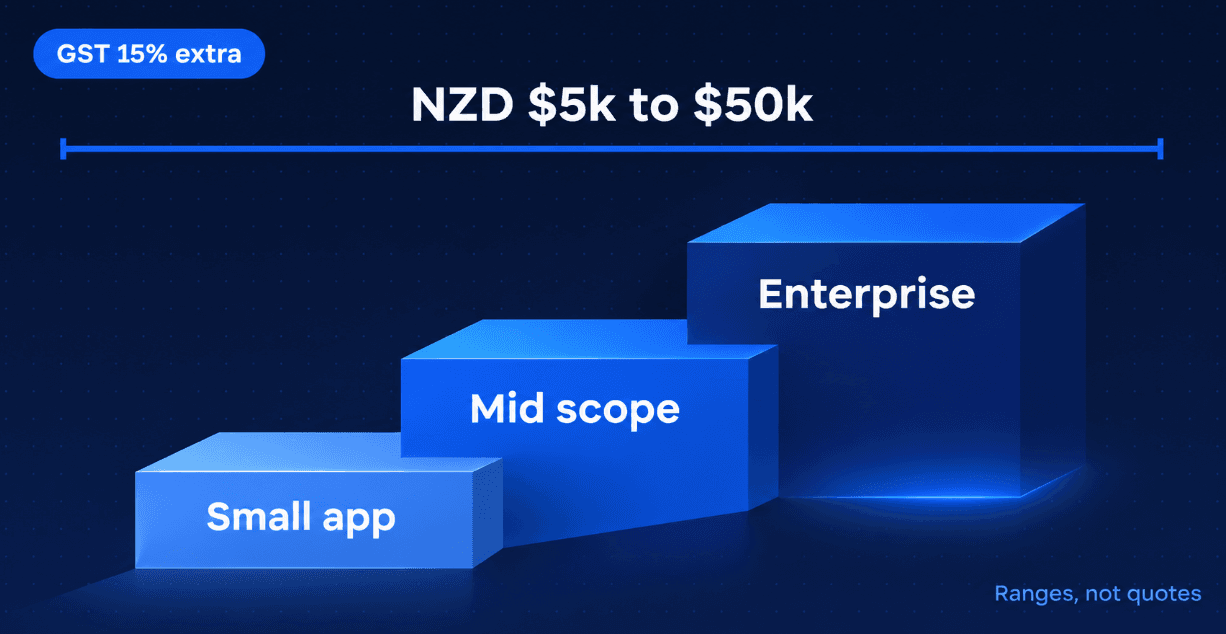
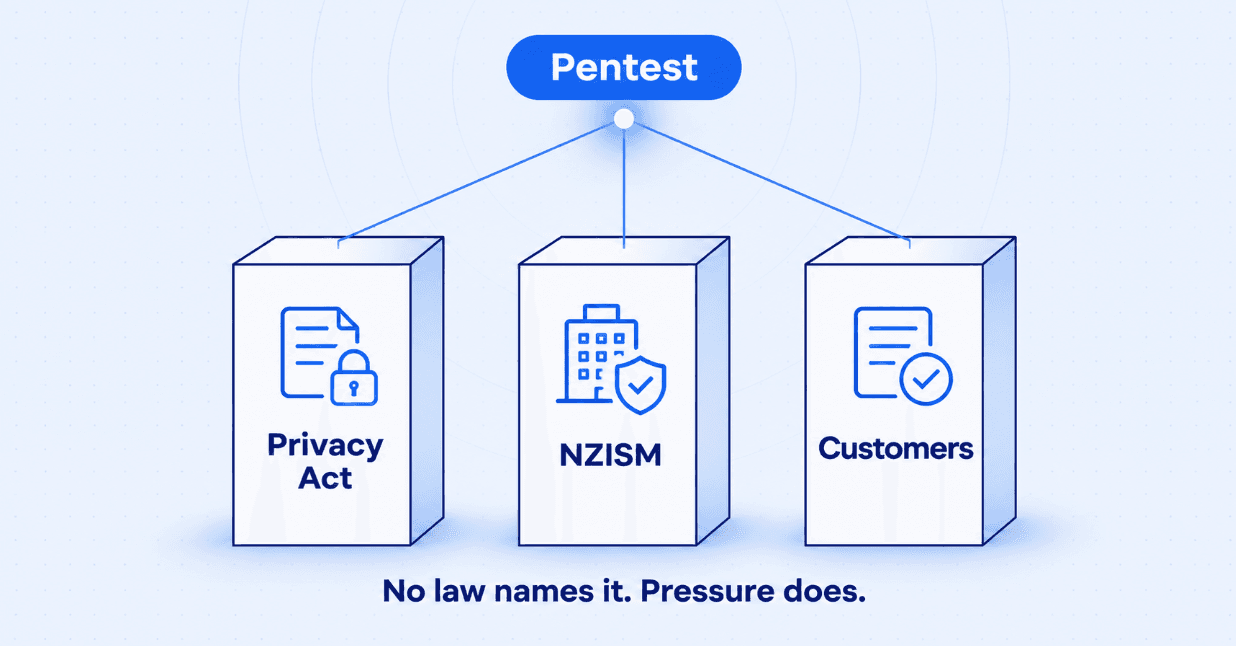
Pentest NZ buyers usually ask one question first: what will it cost, and do we have to do it? Pentesting in NZ typically runs NZD $5,000 to $50,000 depending on scope (what pentests cost). No NZ law we know of makes a pentest mandatory for businesses in general. But the Privacy Act, NZISM and your biggest customers all push you towards one.
The pressure is real. The NCSC's 2026 Cyber Threat Report recorded 369 incidents of potential national significance, and 162 were criminal or financially motivated. This guide covers the rules, the cost, how to pick a provider, how to scope the work and what you should get back.
What do the rules actually say?
No single rule decides this for you. Three pressures stack up, and together they usually settle the question.
The Privacy Act 2020 does not name pentesting. Information Privacy Principle 5 requires reasonable security safeguards for personal information, and regular testing is a practical way to show you met that duty (Privacy Act and pentesting). If a breach could cause serious harm, you must notify the Privacy Commissioner and the people affected as soon as practicable. The Commissioner's guidance says to aim for 72 hours. Failing to notify is an offence with a fine of up to NZ$10,000. For health information, the Commissioner's security standard asks for scheduled testing.
NZISM is the government's information security manual. It is the baseline for agencies under the Protective Security Requirements, and it says agencies should consider penetration testing in their risk assessments. That is a recommendation, not a mandate. Suppliers meet it through contracts, so if you sell to government, expect the question. If a customer sends you a security questionnaire, a recent pentest summary is often the fastest way to answer it. Keep the latest one ready to share under NDA.
For private companies, customers matter most. SOC 2, ISO 27001 and PCI DSS audits all expect evidence of regular security testing (pentesting for compliance).
What does a pentest cost in NZ?
Treat every published figure as a range, not a quote. Capture The Bug's NZ work typically falls between NZD $5,000 and $50,000. Third-party benchmarks, which are vendor claims, put a small web app near NZD $4,000 to $12,000, mid-size scopes at $12,000 to $35,000 and enterprise work from $35,000 upwards. Add GST at 15%. Ask every provider for a fixed price tied to a written scope. If the price changes after kickoff, the scope was vague.
Price moves with the number of apps, APIs and user roles, whether testing is authenticated, how deep the testers go and how many retests you want. Be wary of a web app quote under NZD $2,000 to $3,000. It is likely an automated scan with a pentest label.
How do you choose a provider?
CREST accredits companies, not individual testers. Look the company up on the CREST Marketplace, then ask who will actually test your system (how to verify a CREST-accredited provider). If you ship AI features, ask for the Security Testing of AI accreditation by name.
Then ask for a sample report, who signs it off and what retesting is included. Local knowledge helps too. A provider that knows NZ privacy and government expectations will write findings in language your auditors and board recognise. A provider that cannot show you these before you sign will not improve after (what to look for in NZ pentest services).
How should you scope it?
Start with what an attacker can reach: customer-facing apps, APIs, admin panels, cloud settings and third-party integrations. Decide whether testers get logged-in accounts, and whether they test production or a staging copy. Write down what is out of scope. Agree who to call if a critical issue turns up mid-test. Share architecture diagrams and test accounts before kickoff. Testers who lose a week waiting for credentials spend less time finding problems.
A tight scope with real depth beats a broad scope tested lightly.
How often should you test?
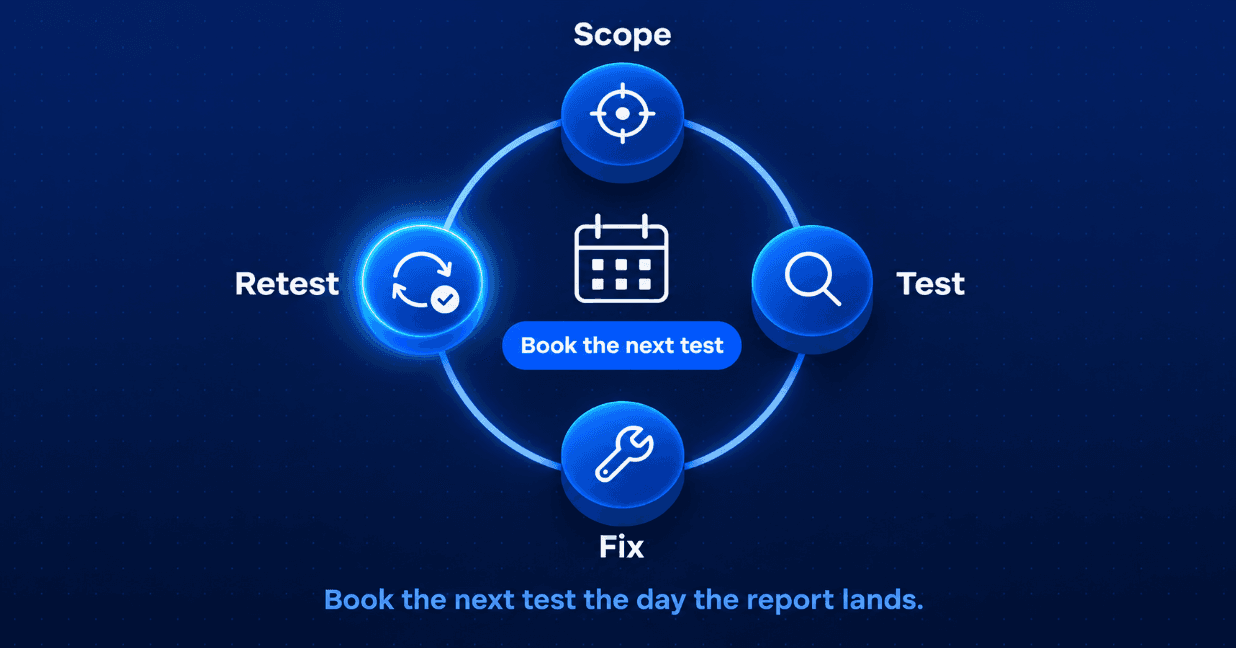
Test at least once a year, and again after major releases, new integrations or infrastructure moves. A yearly snapshot ages quickly if your team ships weekly. For fast release cycles, ask providers about continuous testing so new code gets checked as it lands. Put the next test date in your calendar the day the report lands. Teams that skip this step often test again only when an auditor asks.
What should the report and retest give you?
Every finding should come with evidence, a severity rating and clear fix steps your developers can act on (how to read a pentest report). Then you need a retest that proves the fixes worked. Auditors and enterprise customers ask for that proof (remediation and retesting).
What mistakes waste the most money?
Three come up again and again. First, buying on price alone and then finding the report is a scanner export. Second, scoping only the main website and forgetting the API behind the mobile app. Third, testing once, fixing little and calling it done. A pentest only reduces risk when findings get fixed and checked. Budget for fix time and a retest, not just the test.
Ready to compare scopes and prices? Book your free PTaaS demo with Capture The Bug.
FAQs
How much does pentesting cost in NZ?
Published ranges run from about NZD $4,000 for a small web app to $35,000 or more for enterprise scopes. Capture The Bug's NZ work typically falls between $5,000 and $50,000. These are ranges, not quotes, and GST at 15% is extra.
Is a pentest required by law in NZ?
No NZ law we know of requires one for businesses in general. The Privacy Act 2020 requires reasonable security safeguards, NZISM says government agencies should consider penetration testing, and customers and audits such as SOC 2 often expect one.
What does NZISM say about penetration testing?
NZISM is the baseline for government agencies under the Protective Security Requirements. It says agencies should consider penetration testing in risk assessment. That is a recommendation, not a mandate. Suppliers usually meet it through contract terms.
Does the Privacy Act 2020 require pentesting?
No. It does not name pentesting. Information Privacy Principle 5 requires reasonable security safeguards, and testing is a practical way to show you met it. Serious harm breaches must be notified as soon as practicable. The Commissioner suggests aiming for 72 hours.
How often should NZ businesses pentest?
At least once a year, and after major releases, new integrations or infrastructure changes. Teams that ship weekly often move to continuous testing so new code is checked as it lands.