Updated 16 November 2026. We are Capture The Bug, a NZ pentest provider, so we have a stake in this topic. That is why we do not rank pentesting companies in NZ here. Vendor-written league tables are marketing. You get 12 checks to run on any provider, including us, plus a table that compares four kinds of provider on their merits.
The 12-point checklist
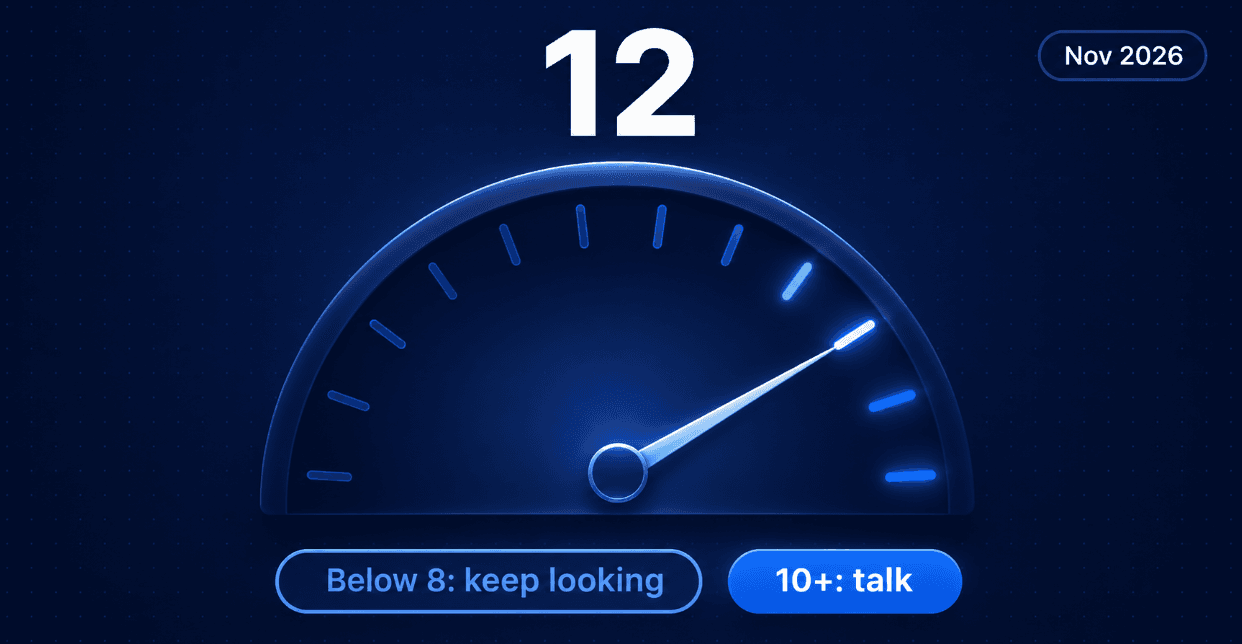
Give each point one mark if the provider passes it with proof, not a promise. Ten or more is worth a proper conversation. Below eight, keep looking.
- Company accreditation. CREST accredits companies, so look the firm up on the CREST Marketplace yourself (how to verify a CREST-accredited provider).
- Named testers. Ask who will test your system and what they have done before. Juniors supervised by seniors is fine. Unnamed is not.
- Real method. Manual testing against recognised guides such as OWASP, with scanners as support, not the product.
- A sample report. Redacted, real, with evidence, severity and fix steps (how to read a pentest report).
- A fixed price tied to written scope. Ranges are normal. Surprises after kickoff are not (what pentests cost).
- Retesting included, with a stated window and number of rounds (remediation and retesting).
- Start date and turnaround in writing. Slow starts hurt release plans.
- Direct contact with testers and findings shared as they are found, not weeks later (PTaaS vs traditional pentesting).
- NZ context. They should know the Privacy Act 2020 and NZISM expectations (Privacy Act and pentesting).
- The right specialism: API, cloud, mobile, or AI. For AI features, ask for the Security Testing of AI accreditation by name.
- Data handling. NDA, insurance, where your data is stored and when it is deleted.
- References from customers of your size and sector. Ask for two.
How the four types of provider compare
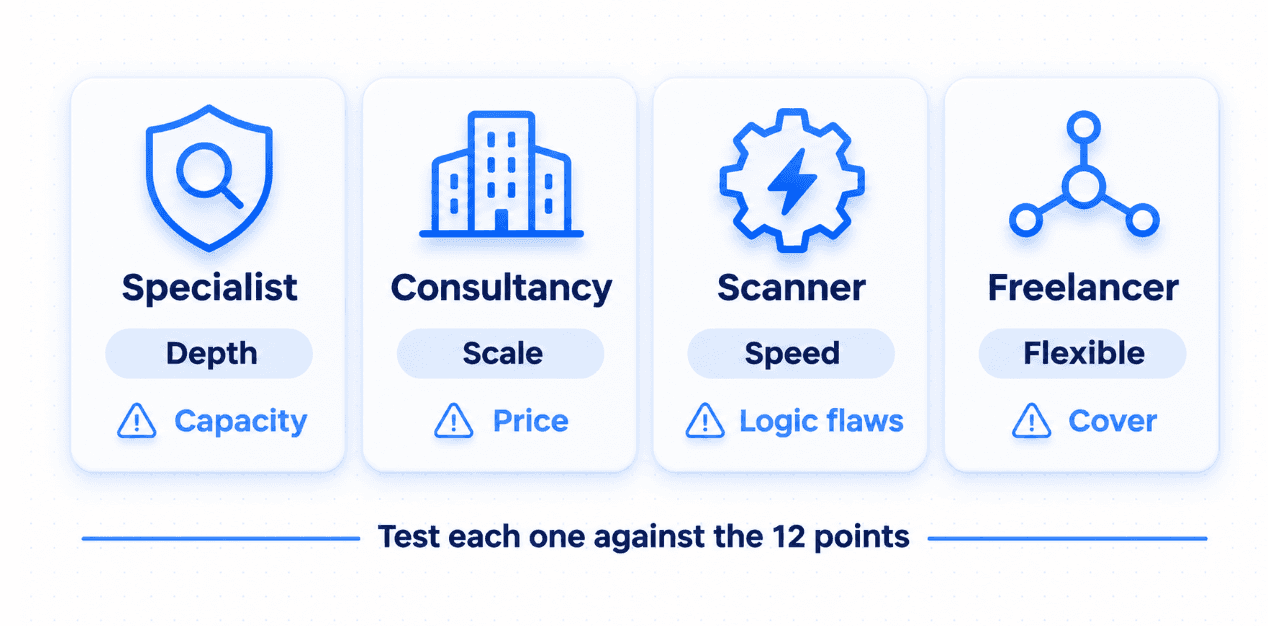
| Type | Where it is strong | What to watch | Best fit |
|---|---|---|---|
| Accredited specialist | Deep manual testing, named testers, sample reports | Smaller teams, so book early | Software firms, fintech, regulated buyers |
| Large consultancy | Broad programmes, board-level reporting | Higher price, junior staffing on routine work | Enterprise with wider risk work |
| Scanner or platform only | Low cost, fast, repeatable | Misses logic flaws, often sold as a pentest | Routine checks between real tests |
| Freelancer or bounty | Flexible, niche skills | Accreditation, insurance and retests vary | Narrow, low-risk scopes |
Treat the table as a starting point. Individual firms vary, so test each one against the checklist.
Many NZ buyers mix types. A common pattern is a scanner for weekly checks and an accredited specialist for deep testing once or twice a year. That gives coverage between tests without paying specialist rates for routine work. Whatever mix you choose, make sure one named person inside your company owns the results.
What to ask on the first call
Ask what they would test first on your product and why. A good tester answers with specifics about your login, user roles and data flows. Ask what they usually find in products like yours. Ask how they handle a critical finding on day two. Ask what they need from your team and how many hours that takes. Vague answers to these questions are a stronger signal than any badge.
How to run the process in a week
Day one, write your scope on half a page and send it to three providers. Days two and three, collect written answers to the 12 points and a sample report from each. Day four, hold one call per provider with a developer in the room, because developers spot vague answers fast. Day five, call two references. Day six, compare scores and total cost including the retest. Day seven, sign with scope, price, dates and retest terms in the contract. This keeps you from buying on the best sales call.
Where we are biased
We sell human-led testing and a PTaaS platform. We hold CREST accreditation, so we naturally rate that signal highly. We also think a scanner export is not a pentest. Weigh our view with that in mind, and check our listing the same way you would check anyone else's.
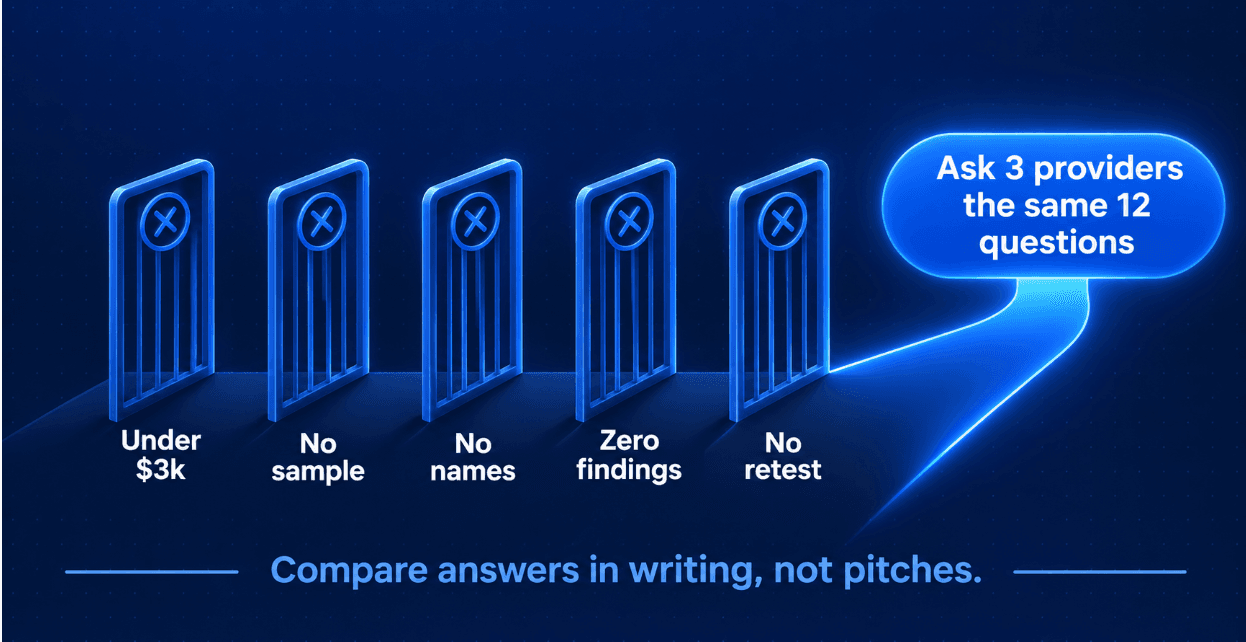
Because we have a stake, we suggest you ask three providers the same 12 questions in writing. Compare answers side by side, not pitches. If a provider will not answer in writing, you have learned something useful.
Red flags that should end the call
A web app quote under NZD $2,000 to $3,000 is likely an automated scan. A quote that arrives within an hour of a first email, with no scoping questions, is a template. A promise of zero findings is not testing, it is theatre. No sample report, no named testers and no retest are each reasons to walk. If you also want the wider picture on rules and budget, our guide to what to look for in NZ pentest services covers it.
Want your shortlist scored? Talk to an expert at Capture The Bug and bring your three quotes.
FAQs
How do I choose a pentest company in NZ?
Use a scored checklist: company accreditation, named testers, real method, sample report, fixed scoped price, retest, communication, NZ knowledge, specialism, data handling and references. Give each a mark and talk seriously only to providers scoring 10 or more of 12.
Does CREST certify testers or companies?
CREST accredits companies. Its individual qualifications are separate, and a company can be accredited without every tester holding one. Check the company on the CREST Marketplace and ask who will do your test.
Which pentesting companies in NZ are best?
We do not rank them. We are a provider, so our ranking would be biased. Run the 12-point checklist on any shortlist, including us, and verify each claim yourself.
What are the red flags when buying a pentest?
A web app quote under NZD $2,000 to $3,000, no sample report, no named testers, a promise of zero findings, and no retest. Any one is a reason to ask more questions.
Is an automated scan the same as a pentest?
No. Scanners find known issues quickly. Human testers chain weaknesses and find logic flaws. Many scans are sold under a pentest label, so ask how much of the work is manual.